 |
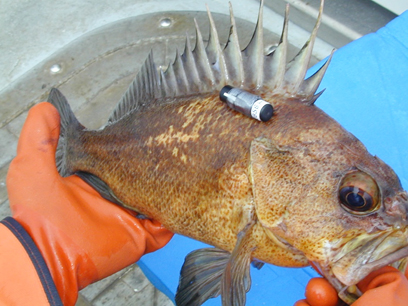
| Quillback rockfish with telemetry tag implanted |
Our research team uses acoustic tags to collect data on fish behavior and movement for the purposes of understanding how fish use their habitat. Acoustic tags are small sound-emitting devices that are surgically implanted or attached. These tags send out signals (i.e., pings) to receiver arrays that are moored to the sea-floor. Based on the speed of arrival of the ping at the receivers, the location and swimming direction of the fish can be calculated. The tags can also collect data on acceleration, depth, and temperature. Fish movement data can inform us about population connectivity, fish home range, and habitat utilization and preference.
In 2016, our team initiated a pilot study to investigate the movements of deacon rockfish in the nearshore reef of Seal Rocks, Oregon. Fish were tagged with coded tags which transmit ID, depth, and accelerometer (activity) data. The acoustic array included a 21 receivers, spaced in a grid and fence pattern, which allowed us to detect fish movements within the grid and would allow us to identify if any fish left the area.
Overall, six fish remained within the array for the entire seven month study period, demonstrating very high detectability and high site fidelity. Preliminary analysis of activity levels shows definitive patterns of activity, depth distribution, and home range, as well as an interesting disruption of that pattern for all six fish, during a period of summertime hypoxia. The Deacon rockfish acoustic telemetry array continued to provide movement data on fish throughout the winter of 2016 through March 2017. Five deacon rockfish remained present and well-detected in the grid through the duration, and tags provided consistent activity and depth data during that time. Our team has conducted similar behavioral and movement studies on many other rockfish species. This work is not currently on-going.
Fish Movement and Behavior Publications and Information Reports |


