 |
 |
 |
 |
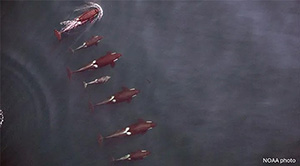 |
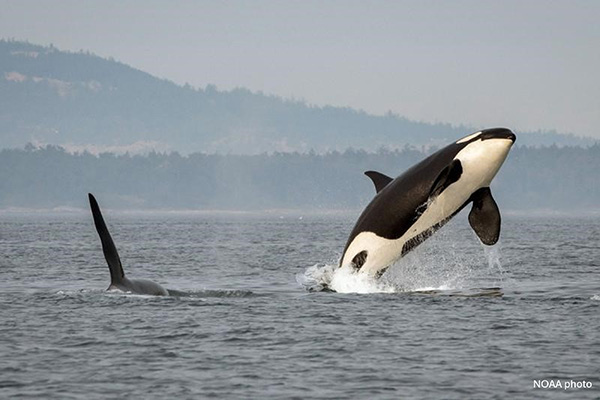
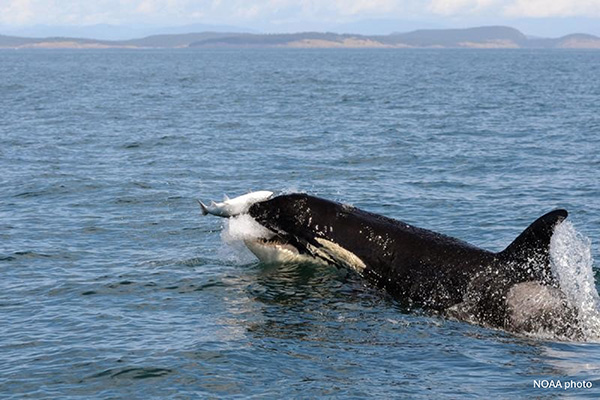
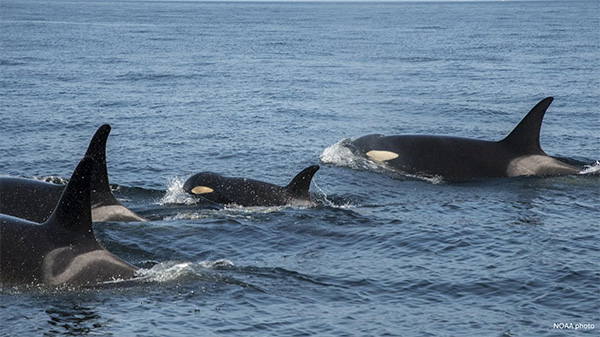
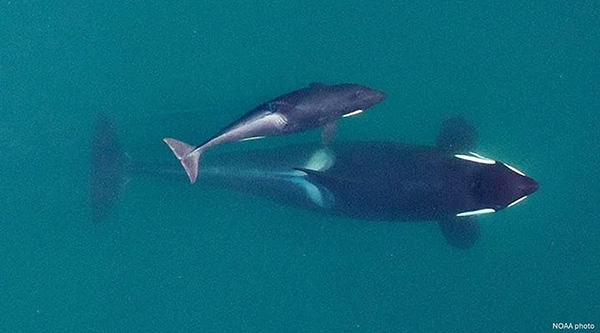
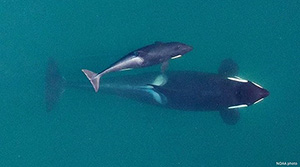
| Photos provided by NOAA. Click on images to enlarge |
To help ensure that management actions taken to support the conservation and recovery of endangered Southern Resident
orcas are implemented effectively and efficiently, Oregon’s state agencies formed the Southern Resident Orca State
Agency Coordination Group. Meetings began in January 2026 and the group’s main purpose is to facilitate communication,
coordination, and collaboration among the seven state agencies involved in Southern Resident orca conservation (Oregon
Department of Fish and Wildlife, Oregon Department of State Lands, Oregon Parks and Recreation Department, Oregon
Department of Environmental Quality, Oregon Department of Land Conservation and Development, Oregon State Marine Board,
and Oregon State Police - Fish and Wildlife Division).
Meeting Summaries:
Background information
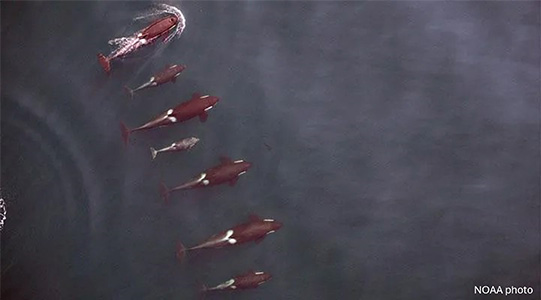
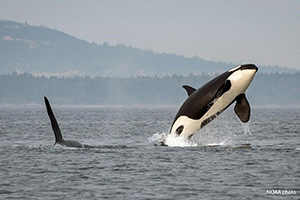
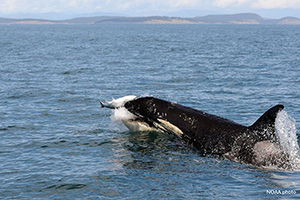
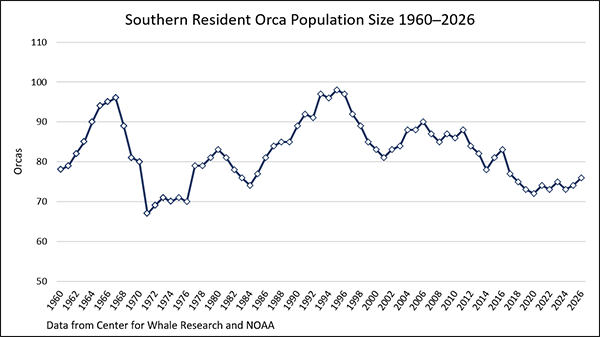
Southern Resident orcas are a distinct population of orcas (also known as killer whales) native to the eastern North Pacific Ocean ranging from southeastern Alaska to central California. Their population is now estimated to number just 74 orcas in three pods (27 in J pod, 14 in K pod, and 33 in L pod).
The Oregon coast is an important travel corridor for Southern Resident orcas in the K and L pods as they move between feeding areas to the north and south. The area near the Columbia River mouth is also a foraging hotspot. In recognition of their importance, Oregon's coastal waters (between the 6 and 200 m depth contours) were federally designated as critical habitat for the Southern Residents in 2021 based on satellite tagging and survey work that revealed their use of these waters.
Of the three orca ecotypes in the northeastern Pacific region—resident, transient, and offshore—resident orcas are distinct in living in large stable pods and relying almost entirely on fish for their diet, particularly Pacific salmon. Transients, also known as Bigg's killer whales, eat marine mammals and offshore killer whales specialize in eating sharks.
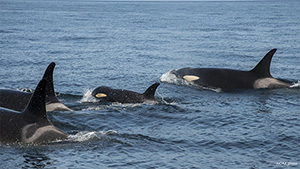
Each Southern Resident orca pod and subgroup has its own distinct culture and language. Their vocalizations used for communication are known to have distinct dialects that reflect their maternal lineages, and they use their echolocation abilities when hunting. The size, shape, coloration, and markings associated with their dorsal fin and "saddle patch" (the area of whitish-gray pigmentation behind the dorsal fin) are unique to each orca and these characteristics can be used to identify and count individual animals for population estimates.
Males grow to be much larger than females (weighing up to 15,520 pounds) and have disproportionately larger fins, especially the dorsal fin that can be 6 feet tall. Females can outlive males (up to 80-90 years, vs. males up to 60-70 years) and live for many years after they stop giving birth; they typically have two to four calves during their lifetime. Orcas are strongly matrilineal, with older females leading the pod and males not involved in the raising of young.
Scarcity of prey (especially Chinook salmon, their preferred prey), sound and vessel disturbance, and exposure to high levels of contaminants are the primary reasons for the decline of Southern Resident orcas since the mid-1990s. They have been listed as Endangered under the federal ESA since 2005 and by the State of Washington since 2004.
In February 2024, the Fish and Wildlife Commission (Commission) listed Southern Resident orcas as Endangered under the Oregon Endangered Species Act (OESA) after receiving a petition to list them from the Center for Biological Diversity, Defenders of Wildlife, and Whale and Dolphin Conservation in February 2023.
Biological Assessment of Southern Resident orcas (pdf) (OESA requires a Biological Assessment summarizing the best available scientific information before a listing decision is made.)
Survival guidelines are also required under the OESA. These apply to actions proposed on state lands or waters and help guide state agencies that play a role in Southern Resident orca conservation until the Commission approves a management plan for these agencies.
Guidelines adopted by the Commission in February 2024 direct relevant state agencies to:
- Further monitor and address pollutants, especially those posing the highest risk for Southern Resident orcas and their prey.
- Increase boater education on the current federal vessel buffer guidelines to reduce vessel and noise disturbance.
- Assess the potential effects on Southern Resident orca communication, navigation, and foraging of projects planned in Oregon's coastal waters. Enhance hatchery Chinook salmon production if capacity and funding exists.
- Increase efforts to prevent oil and other hazardous material spills.
The OESA requires that state land-owning or managing agencies with a role to play in the conservation of an
endangered species develop endangered species management plans. At their August 2025 meeting, the Commission approved management plans from ODFW, Oregon Department of State Lands, and Oregon
Parks and Recreation Department that outline actions the agencies plan to take to contribute to the conservation of
Southern Resident orcas.
The Commission also reviewed conservation memoranda from state non-land-owning or managing agencies (Oregon
Department
of Environmental Quality, Oregon Department of Land Conservation and Development, Oregon State Marine Board, and
Oregon
State Police Fish and Wildlife Division) with a role to play in Southern Resident orca conservation.
We can also take actions in our daily lives to help with Southern Resident orca recovery, such as:
- Using environmentally friendly products
- Not washing cars in driveways
- Disposing of medications at drop-off locations (e.g., participating pharmacies)
- Conserving water for salmon streams
- Minimizing the use of plastics
- Volunteering to help with stream restoration activities (e.g., planting trees in riparian areas) and participating in Oregon's beach clean-up days
Other resources:
|